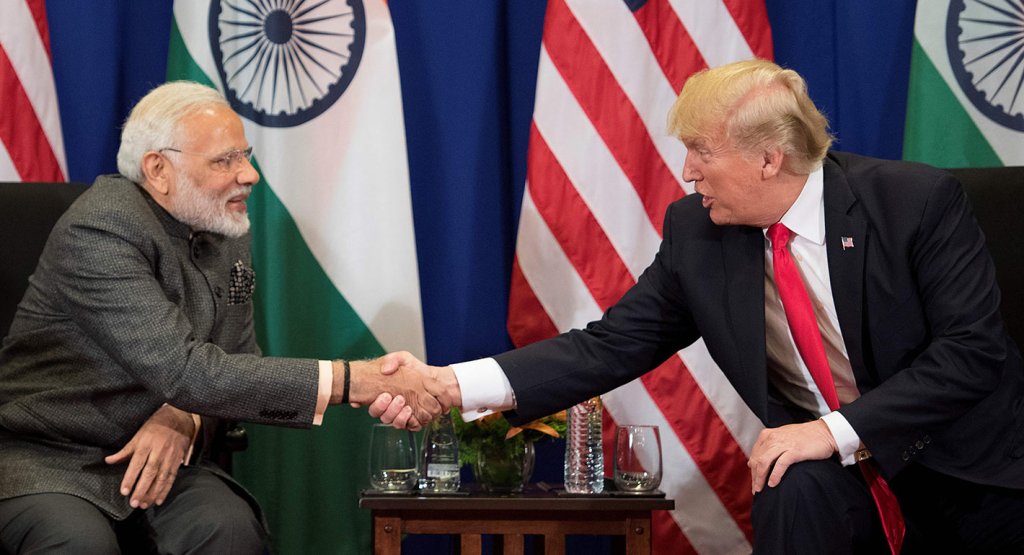
Since the May 2025 Indo-Pak conflict, mainstream outlets have pushed the narrative of a U.S.-Pakistan thaw and a U.S.-India chill. The buzz rests largely on Trump’s remarks, new tariffs, and a flurry of high-level U.S.-Pakistan meetings—symbolically notable, but hardly enough to overturn years of entrenched U.S.-India strategic alignment or unravel Pakistan’s deep-rooted partnership with China.
Coverage of the steep 50% U.S. tariffs on India has been especially exaggerated. In practice, their reach is far narrower. Roughly half of Indian exports to the U.S. are exempt, including petroleum products, pharmaceuticals, and smartphones and electronics—key sectors untouched by Trump’s tariffs. Even auto parts, a $2.6 billion export category, face a reduced 26% duty.
India ships about $80 billion in goods to the U.S. each year, of which $48.2 billion falls under the 50% tariff. Against India’s total global exports of $824.9 billion in 2024–2025, that translates to just 6% directly affected—far from the seismic shock suggested by headlines. Additionally, India has already moved to cushion the blow: its recently signed Free Trade Agreement (FTA) with the U.K.—a close U.S. ally—will see nearly 99% of Indian exports to Britain enter tariff-free.
It is crucial to recognize that Washington has already executed an unmistakable pivot to Asia, anchoring its long-term strategy of “containing China” in what has become a simmering new Cold War. The U.S.-India relationship, on a rapid upward trajectory over the last three decades, has now matured into a central pillar of this strategy.
Since 2017, the U.S., India, Japan, and Australia have formalized their alignment in the Quadrilateral Security Dialogue (Quad), framing themselves as four “democracies” charged with safeguarding a “free and open” Indo-Pacific—language that thinly veils its anti-China thrust.
The U.S. Embassy in India’s “Joint Fact Sheet” on the “comprehensive and global strategic partnership” makes clear the scope of this alignment: a semiconductor partnership to reduce dependency on Beijing, expanded undersea maritime intelligence sharing, deepened cyberspace coordination, and a next-generation defense partnership—which includes the India-U.S. Defense Acceleration Ecosystem (INDUS-X).
There are dozens of other critical agreements and institutional linkages binding the two states across technology, energy, security, and finance. Unlike the episodic, transactional, and often coercive “warmth” that has characterized U.S.-Pakistan ties, the U.S.-India relationship is built on structural, long-term commitments—designed to firmly anchor India within Washington’s strategic orbit.
During the recent unprovoked Israeli aggression against Iran, India—despite longstanding economic and cultural ties with Tehran—refused to endorse the SCO statement condemning the attacks. Instead, it echoed the Western call for ‘mutual de-escalation,’ in contrast to Russia, China, and Pakistan, which affirmed Iran’s legitimate right to self-defense. Investigations reportedly found evidence of India utilizing its tech-infrastructure in Iran to assist illegal Israeli surveillance efforts. India has also aided Israeli war crimes in Gaza.
Coverage of India-Iran ties has remained muted since the imposed 12-day war, though recently, the Iranian Embassy in India urged Indian media to stop spreading anti-Iran propaganda. Meanwhile, India held a high-level meeting with Israeli officials, during which Indian defense secretary “reiterated India’s zero tolerance approach to terrorism and condemned the October 7, 2023, terrorist attacks in Israel and called for the release of all hostages.”
Though the media frenzy will likely persist in the coming months, U.S.–India relations are unlikely to meaningfully drift. Similar strains arose during Trump’s first term, when Washington revoked India’s Generalized System of Preferences status and sharply criticized its tariffs. After India–Pakistan clashes, Trump also met with a Pakistani leader—though in that case the prime minister rather than the army chief.
While some reports portray General Asim Munir’s visit to the White House as unprecedented, Pakistani army chiefs have long been received there, reflecting Washington’s recognition of the military’s role in governance regardless of explicit martial law. Even during the most strained phase of the U.S.–Pakistan relationship in the War on Terror, particularly from 2008 onward, former army chiefs General Ashfaq Parvez Kayani and General Raheel Sharif were hosted at the White House on several occasions.
Over the last two decades, U.S. think tanks closely aligned with the country’s foreign policy have described Pakistan, particularly its military-intelligence apparatus, as “an ally from hell”, a “menacing problem”, and in need of “containment”. U.S.–Pakistan relations—while appearing steadier than in recent years—remain shallow, lacking the institutional depth that defines Washington’s partnership with New Delhi.
The two countries’ national interests often diverge, a fact reflected in a 2023 U.S. Congress review of the relationship, which bluntly describes Pakistan as “a country of more than 200 million people with nuclear weapons, numerous Islamist terrorist groups, and increasingly close ties to China.”
Additionally, the document states,
“Pakistan and China have enjoyed what both call an “all-weather friendship” for more than four decades, and both countries retain long-standing rivalries with India. Some observers in both New Delhi and Washington see China working with Pakistan to constrain India’s influence, and China has provided diplomatic support for Pakistan’s Kashmir and foreign policies. Beijing is Pakistan’s primary international benefactor and arms supplier, and Chinese investments, companies, and workers are increasingly present in Pakistan. Military-to-military ties are extensive.”
U.S.–India ‘tensions,’ though overstated, are expected to stabilize, with India anchored in the Western bloc—even as Modi uses media hype to tout ‘strategic autonomy.’ By contrast, Pakistan shows no sign of drifting from China and is deepening ties with Iran. Since 2021, Pakistan, Iran, China, and Russia have convened annual quadrilateral meetings to cooperate in their approach towards Afghanistan. Further, Russia has recently emphasized its expanding bilateral ties with Pakistan, signaling Islamabad’s pursuit of strategic partnerships with regional powers while continuing diplomatic, economic, and counterterrorism cooperation with the United States.
