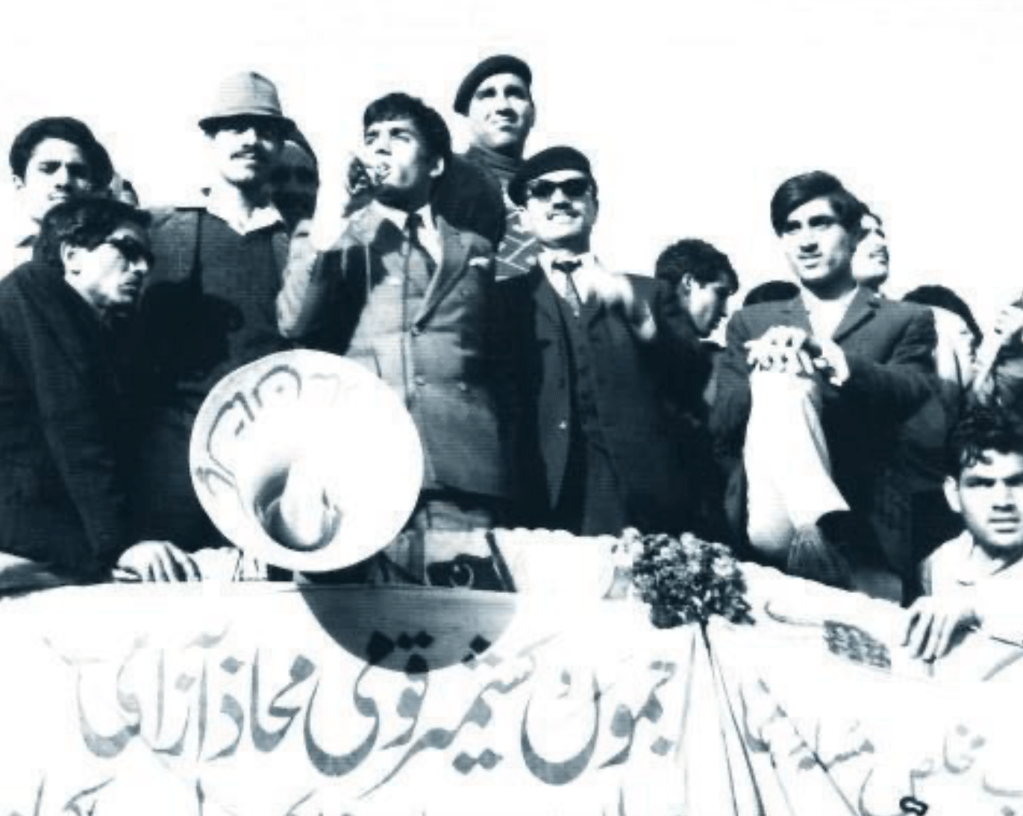
Much of the discussion surrounding Kashmir today rests on a false equivalence between India and Pakistan—or between Indian-Occupied Kashmir and Azad Kashmir. While Azad Kashmir is not without its own governance and socioeconomic grievances, presenting the two sides as equivalent obscures the principal contradiction that has defined the conflict for nearly a century and, in practice, reinforces the status quo.
The central argument of this series is that the driving force behind the Kashmir dispute has historically been the struggle of Kashmir’s Muslim majority against first the Dogra State and later the Indian State. More specifically, it has been a struggle of Muslim subjects against a Hindu nationalist monarchy and, subsequently, an Indian state built on a Hindu majoritarian order.
Although Muslims constituted roughly three-quarters of the population of the Dogra-ruled State of Jammu and Kashmir, they were systematically excluded from the upper ranks of the civil service, military, and educational institutions while bearing a disproportionate burden of taxation and forced labor. Political power, landownership, and state patronage remained concentrated in the hands of the Dogra monarchy and a small Hindu elite.
The emergence of mass Muslim politics in Kashmir was thus not simply the product of religious sentiment, but of a communal structure in which political power, economic privilege, and religious identity were inextricably linked.
The first major Kashmir Valley-based uprising against Dogra rule occurred in 1931, when protests over the killing of Muslim demonstrators evolved into a challenge to the political and economic domination of the Dogra monarchy. Out of this movement emerged the Jammu and Kashmir Muslim Conference (JKMC), established by Mirwaiz Muhammad Yusuf Shah, and Sheikh Abdullah.
Disagreements soon emerged within the movement over its future direction. At the center of these disagreements was Sheikh Abdullah’s effort to transform the Muslim Conference into a secular organization. Abdullah’s ideological evolution was shaped substantially by the changes in his life following his release from prison in 1933.
He cultivated increasingly close ties with non-Muslim, elite political circles and married Akbar Jehan, the daughter of a Kashmiri woman and Harry Nedou, the European owner of the Nedous hotel chain. Over the following years, Abdullah’s social standing and material circumstances changed dramatically, and he eventually became one of the wealthiest figures in the state.
In 1939, Sheikh Abdullah reorganized his faction as the Jammu and Kashmir National Conference (JKNC), advocating a secular program that sought support from the elite Pandit community and aligned closely with the Indian National Congress.
In 1944, the leaders of both the Muslim Conference and the National Conference invited Muhammad Ali Jinnah to mediate their dispute. Although Jinnah accepted the invitation, his efforts proved unsuccessful. The episode also marked the first major political rupture between Jinnah and Abdullah.
Jinnah rejected Abdullah’s secular reorientation, maintaining that the Muslim Conference—not the National Conference—was the legitimate representative of the political aspirations of Kashmir’s Muslim majority.
The failure to bridge these differences cemented the division of Kashmiri politics into two competing currents: one that identified with India and another that identified with Pakistan. This split would profoundly shape the political trajectory of Kashmir in the years leading up to Partition and beyond.
Partition, the Poonch Rebellion, and the Tribal Assistance
The Partition of British India has often been portrayed on the left—partly as a legacy of the historical influence of Indian nationalism within sections of the international left—as a fundamentally reactionary act. Some even argue that Partition itself was a British strategy to “carve up” India.
However, both British and American officials opposed Partition, fearing that it would reduce the prospects of a large, unified South Asia capable of serving as a strategic anti-communist partner in the emerging Cold War. In many respects, those concerns proved well founded.
Rather than forming a common geopolitical bloc, India and Pakistan pursued divergent foreign-policy trajectories. This divergence became especially pronounced following the Sino-Soviet split, whose geopolitical consequences reshaped Cold War alignments across South Asia.
From the mid-1950s onward, India developed increasingly close ties with the Soviet Union while maintaining relations with the Western powers. Pakistan, by contrast, aligned closely with the West during the 1950s before forging strategic partnership with China in the 1960s, while likewise retaining relations with the Western bloc.
These divergent trajectories would later shape the diplomatic course of the Kashmir conflict. Its origins, however, were bound up with Partition itself and the political upheavals of the final months of British rule.
In June 1947, just two months before the independence of India and Pakistan, a “no-tax” movement emerged in the Poonch district and soon developed into a broader rebellion against Dogra rule. The following month, the state’s Muslim population was ordered to surrender its weapons. Although many villages complied, alarm spread as confiscated arms began appearing in the hands of Hindu and Sikh militias.
Between July and August, the Poonch resistance established its first contacts with tribal groups in the North-West Frontier Province (NWFP), seeking access to arms through a region already known for weapons manufacturing and smuggling.
This chronology matters because mainstream accounts reverse the sequence of events, portraying the tribal intervention as a Pakistani project imposed from outside while minimizing—or omitting—the indigenous rebellion that preceded and ultimately invited it.
On August 14th and 15th, 1947, crowds across Poonch and Srinagar celebrated the creation of Pakistan, waving Pakistani flags despite the Maharaja’s orders. Martial law followed, and by the end of August armed clashes broke out between the Jammu and Kashmir State Forces and the local Muslim rebellion.
By September 1947, the rebellion acquired formal leadership under Mohammad Ibrahim Khan, a young lawyer associated with the JKMC. After escaping Srinagar, he travelled to Pakistan seeking assistance from Muhammad Ali Jinnah.
Contrary to many popular accounts, Jinnah declined to meet him directly. Although he regarded Kashmir as a natural part of Pakistan, he wished to avoid creating the impression that the Pakistani state was directing the uprising.
Ibrahim Khan nevertheless established a base in Murree, from where arms and ammunition were smuggled through Jhelum into Mirpur and Poonch, allowing the rebellion to continue expanding.
At the same time, Jammu witnessed large-scale massacres of Muslims carried out by Hindu and Sikh militias alongside elements of the Jammu and Kashmir State Forces. At least 300,000 fled into Pakistan, while an estimated 200,000 were killed.
These events transformed local resistance to Dogra rule into a struggle intertwined with Partition itself. Reports of the massacres in Jammu inflamed public sentiment, particularly in the NWFP and Punjab, where many came to view the situation in Kashmir as demanding immediate action.
In early October, some officials within the newly established Pakistani government began exploring what assistance might be extended to the Kashmiri rebels. Muhammad Ali Jinnah, however, remained unaware of these efforts.
Because both Pakistan and India were still British dominions, any covert support for the rebellion had to be concealed from the British officers who continued to occupy the highest command positions in the Pakistan Army. Little meaningful assistance was ultimately provided during this period.
Nevertheless, the Dogra Maharaja accused Pakistan of orchestrating the rebellion. Around the same time, he also blamed the Government of Pakistan for the supply shortages developing within the state. In reality, these shortages were largely the result of the widespread communal violence accompanying Partition, which had severely disrupted transport and trade routes across the Punjab, together with the massive refugee movements and broader shortages of essential commodities, including coal.
Soon afterward, on October 18th, the Maharaja warned the Government of Pakistan that unless it withdrew its alleged support for the rebellion, he would have no choice but to seek “friendly assistance.”
Pakistani officials interpreted this as a veiled reference to military assistance from India and condemned the warning, arguing that it was intended both to suppress the Muslim uprising and to clear the way for the Maharaja’s accession to the Indian Union. This exchange makes clear how far the dispute had already progressed by the third week of October 1947.
Before the arrival of the Pashtun tribesmen, the conflict that would become known as the Kashmir dispute had already unfolded through successive stages since at least June.
The events that followed—the arrival of the tribal lashkars, India’s military invasion, the “Instrument of Accession,” and the intervention of the United Nations—can only be understood against the backdrop of the local rebellion, communal violence, and political upheaval that had engulfed the princely state over the preceding months. Yet it is precisely this formative period that is obscured in both Indian nationalist storytelling and the UN resolutions on Kashmir.
