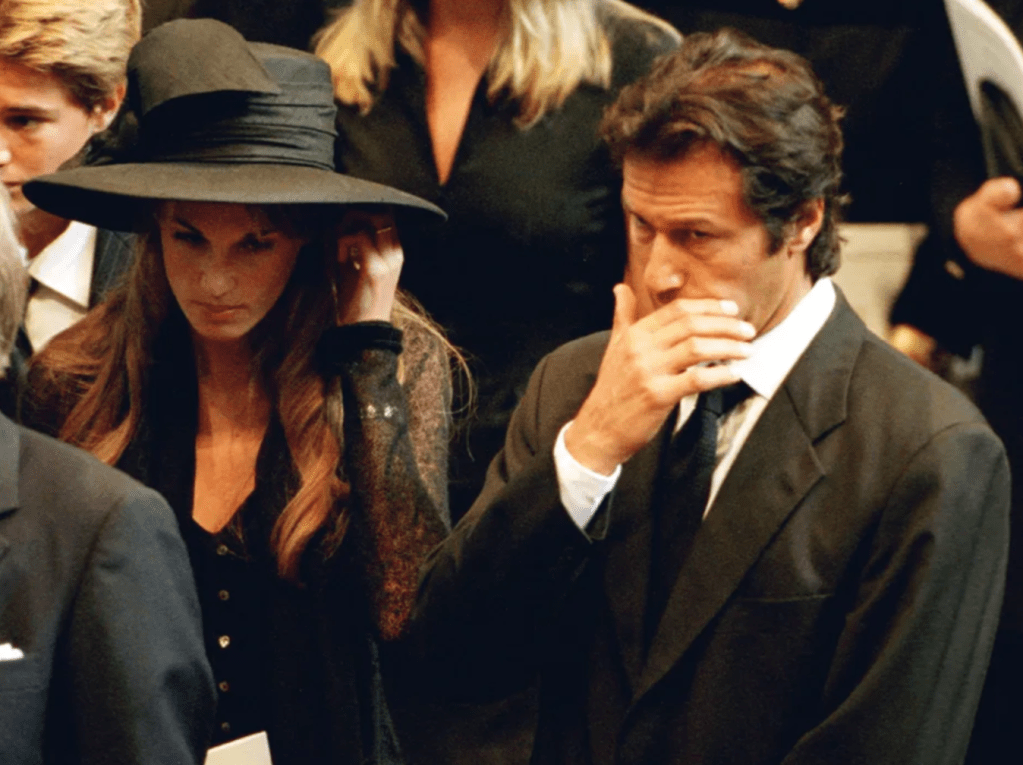
The ongoing release of the Epstein Files in batches on the U.S. Department of Justice website has stirred a growing wave of intrigue in Pakistan. The files have particularly drawn attention due to potential ties to Imran Khan, the imprisoned former Prime Minister and chairman of Pakistan Tehreek-e-Insaf (PTI).
In November 2025, supporters of Khan’s party—alongside PTI-linked figures and Western journalists from George Soros–funded media outlets such as Drop Site News—moved quickly to the fore, presenting the documents in a manner favorable to Khan.
Their claims hinge on a single, carefully selected document, despite several of the released files mentioning Khan (and Pakistan).
The file they have chosen to spotlight is a text exchange between Steve Bannon and Jeffrey Epstein, which took place shortly after Imran Khan was announced as the incoming Prime Minister of Pakistan following the 2018 general election.
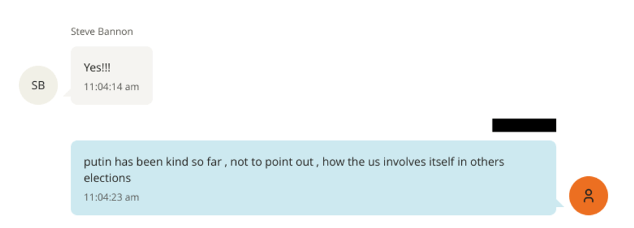
The reference to Khan emerges after an initial comment about Vladimir Putin being “kind so far,” a remark framed around Putin’s restraint in not highlighting U.S. interference in the elections of other countries.
(Note: This exchange took place amid the then-ongoing, Democrat-driven “Russiagate” conspiracy in the United States, which centered on now-discredited claims of “Russian interference” in the 2016 U.S. presidential election.)
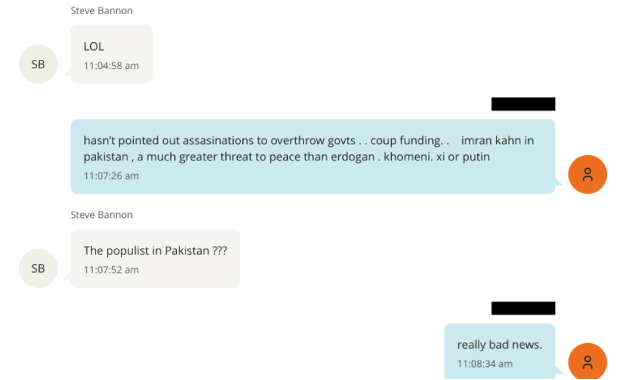
Epstein elaborates by stating that Putin has refrained from pointing out U.S. “assassinations to overthrow governments… coup funding… Imran Khan in Pakistan, a much greater threat to peace than Erdogan, Khamenei [sic], Xi, or Putin.”
The ambiguity lies in whether Epstein is labeling Khan personally as a greater threat or commenting on U.S. interventionism.
Khan’s supporters argue that the passage should be read as Epstein characterizing Khan himself as a greater threat to peace than the other leaders mentioned. That interpretation is grammatically plausible.
However, an alternative reading is equally grammatically defensible: that Epstein is listing examples of U.S. interference—overthrowing governments, funding coups, and backing figures such as Imran Khan in Pakistan—and noting that Putin has been “kind” in not calling out these actions, despite Washington labeling other leaders as threats to global stability.
Under this second reading, the phrase “a much greater threat to peace” does not target Khan personally but instead points to the hypocrisy in U.S. foreign policy which Epstein is naturally aware of.
The recipient of the message seems to interpret it closer to the first. Bannon’s response suggests confusion over why “the populist in Pakistan” would be considered worse than the “Islamist,” indicating that he read the remark as a comparison between leaders.
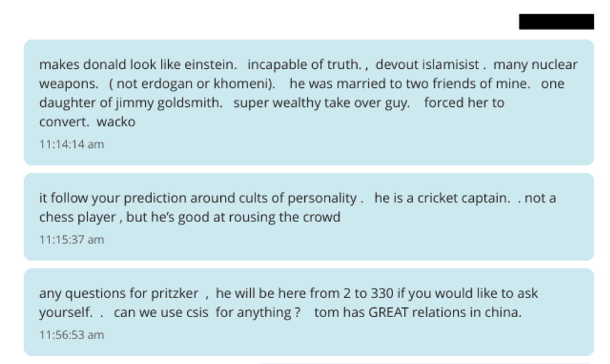
Epstein goes on to state that Khan makes Donald Trump “look like Einstein”. He further describes Khan as “incapable of truth” and a “devout Islamist.” Crucially, Epstein writes “many nuclear weapons (not Erdogan or Khamenei).”
The parenthetical clarification “not Erdogan or Khamenei” appears to respond directly to Bannon’s question contrasting the “populist in Pakistan” with the “Islamist.”
Epstein seems to be clarifying that, in the specific context of nuclear weapons, the “populist” (Khan) could be seen as a greater concern than the “Islamist” (Khamenei or Erdogan), rather than implying Khan is inherently a bigger threat than any of these leaders individually. He does not mention Xi or Putin this time—both nuclear-armed leaders.
Epstein also notes being friends with two of Khan’s ex-wives, specifically highlighting Jemima Goldsmith, the daughter of British financier and politician Sir James Goldsmith.
The exchange concludes with observations on cults of personality, with Epstein claiming that while Khan is a cricket captain rather than a chess player, he does excel at rallying and energizing the crowd.
Admittedly, this exchange alone is inconclusive. It can plausibly be read in either direction. Epstein himself seems somewhat scattered, especially after Bannon asks for clarification on why Khan is supposedly a greater threat.
Under the PTI-aligned interpretation, Epstein appears to contradict himself—first implying that Khan is a greater threat than all four leaders mentioned, then seemingly narrowing the concern to nuclear weapons, which Khamenei and Erdogan do not possess. It’s possible that Epstein had knowledge about Khan’s election that Bannon did not.
Relying on these texts alone—as PTI-aligned journalists have—could easily lead one to the conclusion that Imran Khan is a greater threat than Ayatollah Khamenei, as laughable as that claim is on its face.
It is worth mentioning that Jemima, and her (Zionist) brother Zac Goldsmith, secretly filed an order to gag the UK press about their compromised emails in 2008—as published by Wiki Leaks.
Additionally, Sir James Goldsmith, Imran Khan’s former father-in-law, also known as “Jimmy Goldsmith,” appears in several other Epstein files.
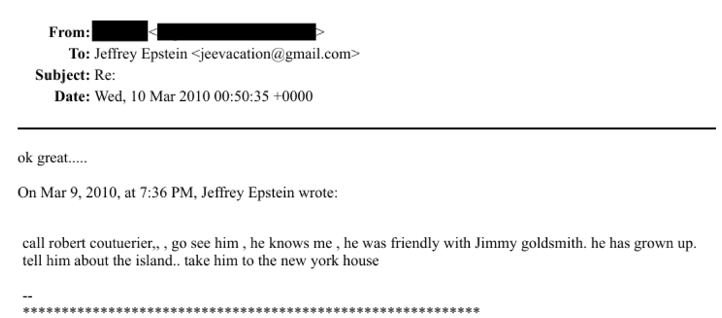
Most notable is a 2010 email exchange with a redacted recipient, where Epstein instructs them to call Robert Couturier—the architect of Goldsmith’s estate—and to “tell him about the island” and “take him to the New York house.” The exchange makes it clear that Epstein was already acquainted with Couturier and aware of his connection to Goldsmith.
With a fuller understanding of Khan (and Pakistan), as well as a look at the Epstein files that PTI-aligned outlets have ignored, the party’s rush to frame the story in this way may obscure other interpretations—leaving questions about the extent of foreign influence in Khan’s rise and its implications for Pakistan.
Additional Epstein Files Relevant to Imran Khan
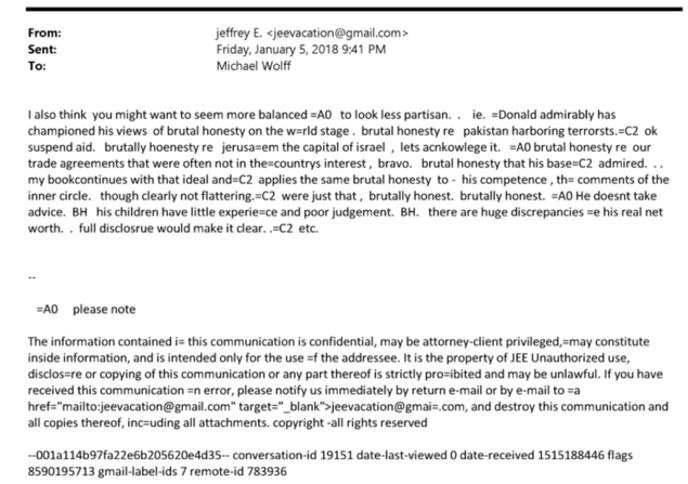
In January 2018, more than six months before the election that brought Imran Khan to power, Epstein refers to Donald Trump’s “brutal honesty” as admirable. He goes on to note Trump’s comments that Pakistan harbors terrorists and the subsequent suspension of U.S. aid.
This suggests that, even before Khan’s rise, Epstein aligned with long-standing Indian and Western narratives portraying Pakistan (or particularly its military-intelligence apparatus) as a sponsor of terrorism.
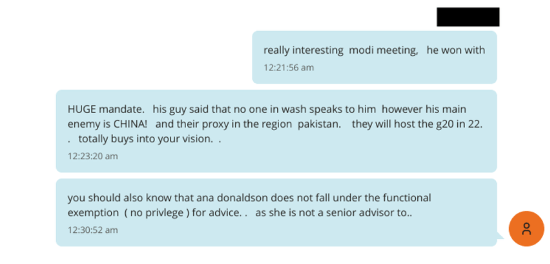
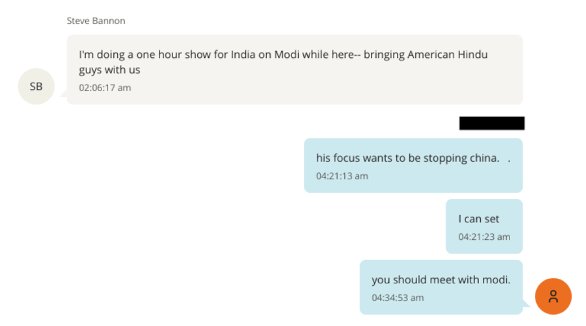
In a 2019 text exchange with Steve Bannon, Epstein (identity is revealed in a different format of the same exchange elsewhere) notes that Indian Prime Minister Narendra Modi’s primary enemy is China and its “proxy in the region”—Pakistan.
Epstein states that Modi’s foreign policy “totally buys into” Bannon’s vision.
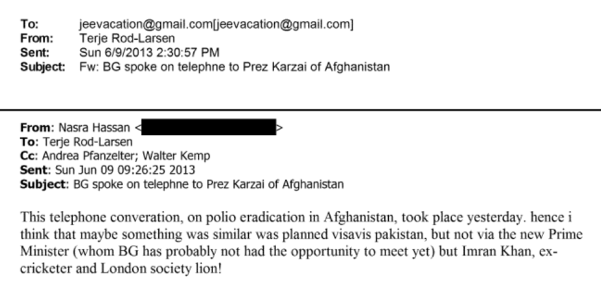
In a 2013 email exchange between Norwegian diplomat and former International Peace Institute President Terje Rød-Larsen and former UN official Nasra Hassan, Hassan refers to Khan as a “London society lion”.
Notably, it was Imran Khan—not the recently elected Prime Minister Nawaz Sharif—who held a phone conversation with Bill Gates on polio eradication.
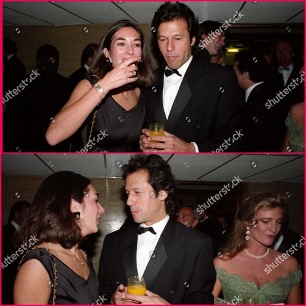
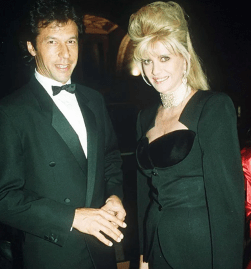
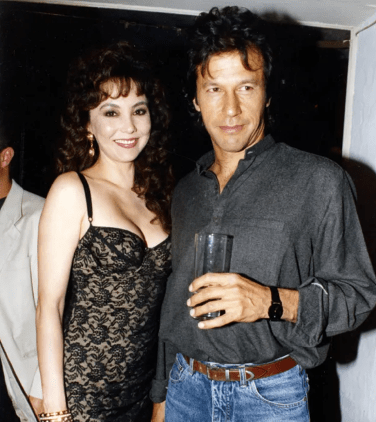
Photos (not from the Epstein files) of Khan’s social activities in London during the 1990s-2000s.
In November 2018, Narendra Modi and Imran Khan were scheduled to meet on the sidelines of the UN General Assembly, at Khan’s request. The meeting was canceled shortly after being announced, and a summary of the events was emailed to Jeffrey Epstein by a sender whose name has been redacted in the documents.
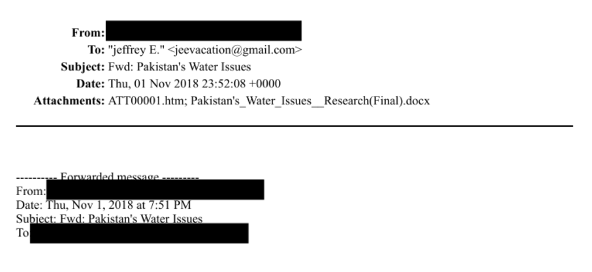
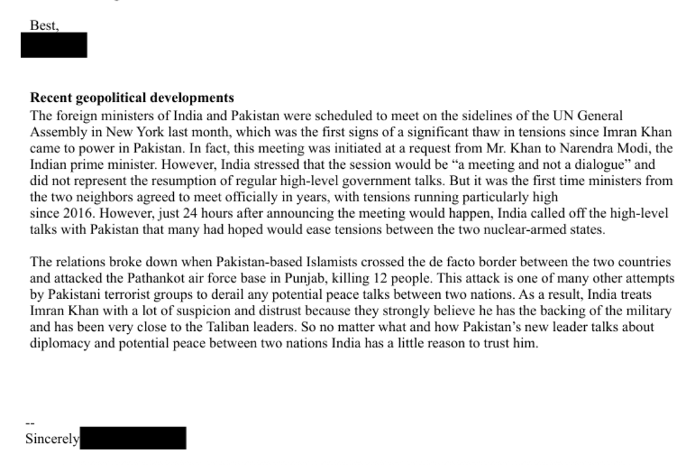
Here, the implication—long echoed in mainstream media and largely accurate—is that the Pakistani military and ISI have been the primary obstacles to “peace” with India, which has historically been acceptable to New Delhi only if it came at the cost of Kashmiri self-determination. Consequently, India, assuming that Khan had the military’s backing, remained skeptical of his offer for dialogue.
Separate from those documents, it is important to contextualize the claim of Imran Khan as a “bigger threat than Ayatollah Khamenei” in that figures such as Zalmay Khalilzad—a “former” U.S. official supportive of the U.S. invasion of Iraq and of regime-change efforts in Iran (and previously Syria)—have emerged as vocal advocates for Imran Khan and calls to “democracy” in Pakistan.
Khan also appears to be a rare case among U.S.-ousted leaders (his own claim, which he later retracted) in receiving sustained sympathy from corporate Western media and U.S. officials.
Readers are encouraged to return to the sole document being highlighted by PTI-aligned media outlets and assess it anew, weighing for themselves which interpretation ultimately makes the most sense.
