Part 2 of our series exploring the dominant perception that the Taliban are a “Pakistani creation“.
Read Part 1
In 1995, The Washington Post reported what it identified as the Taliban’s first military operation:
“In its first operation, last summer, the group staged a lightning attack on an armory controlled by one of the country’s most powerful militias, the Hezb-i-Islami, in the southern Afghan town of Spin Buldak.”
This early account situates the Taliban’s emergence directly in opposition to Gulbuddin Hekmatyar’s forces. Yet, as noted in the first installment of this series, on September 29, 1994, the U.S. House of Representatives was criticizing Pakistan for its continued support for Hekmatyar. According to Ahmed Rashid’s widely cited but dubiously sourced book Taliban—Pakistan was already planning to abandon Hekmatyar in favor of the Taliban before the latter’s Spring 1994 meeting with Burhanuddin Rabbani.
More of Ahmed Rashid’s Revisionism
Rashid’s work is riddled with inconsistencies—some of which are worth noting as part of what appears to be a deliberate effort to reshape the record of U.S. involvement in Afghanistan.
For example, Rashid claims that the United States opposed the return of ex-King Zahir Shah after the ouster of the communist government:
“Also popular was the National Islamic Front led by Pir Sayed Ahmad Gailani, who advocated the return of the Durrani ex-King Zahir Shah to lead the Afghan resistance — a move that was strongly opposed by Pakistan and the USA. The ex-King was living in Rome and continued to be a popular figure amongst the Kandaharis, who hoped that his return would reassert the leadership role of the Durrani tribes.”
Contrary to Rashid’s blatant lie, a declassified CIA file from 1984 makes no mention of U.S. opposition to the King’s return. In fact, only the USSR, Pakistan, and some mujahideen leaders were opposed to such an initiative.
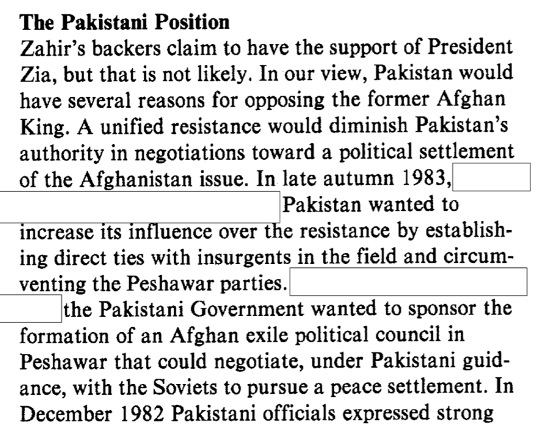
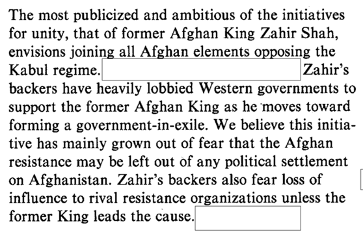
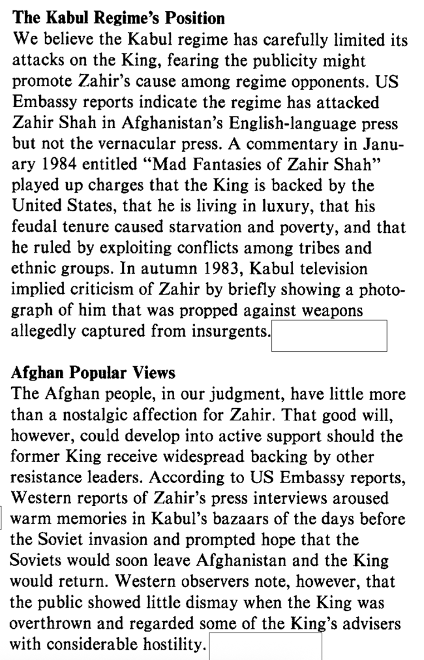
Another declassified CIA document from 1986 notes Sayed Gailani’s positive engagements with Western circles and his “poor relations with Pakistani officials.”
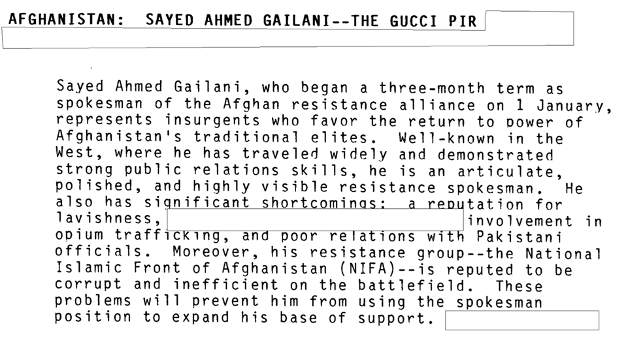
The United States’ incessant desire to reinstall Zahir Shah continued even after the 2001 invasion of Afghanistan. WikiLeaks cables reveal that the former King remained in contact with U.S. officials, exploring possibilities for a return, donating funds to promote “democracy” in Afghanistan, and discreetly advising the U.S. on the Loya Jirga.
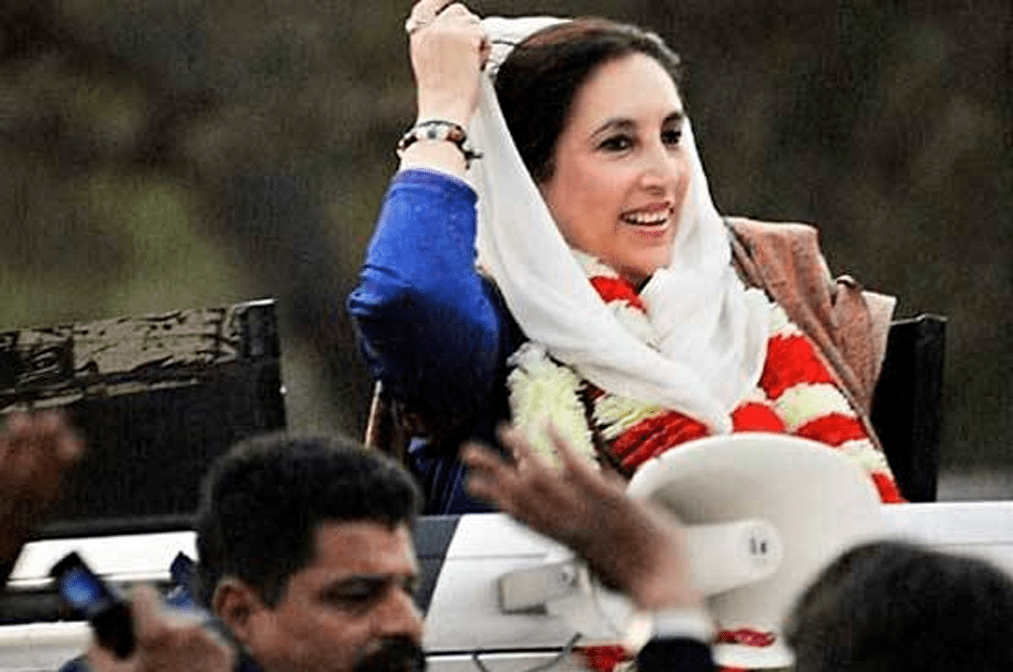
Benazir Bhutto: Washington’s Darling
Rashid, echoing Western media narratives from the mid-1990s, has also claimed that Prime Minister Benazir Bhutto was one of the masterminds behind the Taliban. While this element of the Taliban’s origin story has some basis, it comes with significant caveats left out of by Rashid.
It is important to note that following the death of military ruler Zia-ul-Haq, Bhutto came to power in 1988 with the enthusiastic support of the United States. Such a statement is often met with the counterargument that Zia himself acted at Washington’s behest during the anti-communist jihad in Afghanistan. However, as noted in previous articles on the subject, the Afghan jihad was a complex conflict involving numerous external powers—Pakistan, Iran, China, the United States, Saudi Arabia, and others—each pursuing distinct, and sometimes conflicting objectives—particularly after the Soviet withdrawal in 1989.
The military establishment’s mistrust of Bhutto—often portrayed solely as the institution’s aversion to “democracy”—ran far deeper. Ghulam Ishaq Khan, a senior bureaucrat who had served under Zia’s martial law, delayed convening the National Assembly for Bhutto’s swearing-in until she provided assurances of non-interference in the Afghanistan policy, nuclear program, or defense affairs. Bhutto was even formally prohibited from entering the facilities where Abdul Qadeer Khan conducted his research.
A 1993 New Yorker article observed that analysts suspected Bhutto had been “cut out of—or had chosen to remove herself from” Pakistan’s nuclear program, which—to Washington’s dismay—continued uninterrupted. Though celebrated by Pakistan’s liberal and “left-wing” circles, Bhutto was markedly compliant with U.S. policy priorities—so much so that one could argue she was the most pliable Pakistani leader to date, whether in uniform or civilian dress.
In 1989, U.S. policy analysts at The Heritage Foundation advised the Bush Administration:
“George Bush should appoint a special envoy with ambassadorial rank to consult with Afghan resistance leaders…and coordinate U.S. policy on Afghanistan. Working with the U.S. embassy in Islamabad, this envoy should press…Prime Minister Benazir Bhutto to reconsider the late President Zia’s commitment to Hekmatyar’s Hezb-i-Islami and to push Hekmatyar to cooperate fully with other groups. The special U.S. envoy should warn the Peshawar parties that if they are unable to work together to form a new government then Washington will bypass them and channel aid directly to the field commanders inside Afghanistan…”
Unsurprisingly, Bhutto would soon, in her own words, criticize the Pakistani military-intelligence establishment’s alignment with Hekmatyar:
“There were significant elements within it [the Afghan mujahideen] that were more open to cooperation and civility with the West… But the hard-liners [Hekmatyar] were supported by General Zia … the ISI, looking beyond the end of the war, seemed keen on developing close working relations with these elements within the mujahideen whom they would try to empower to rule the new Afghanistan and give Pakistan strategic depth by extending Islamabad’s influence northward to counter Kabul’s traditional ties with India.”
Within the lexicon of Western policy analysis, terms such as radical and hard-liner seldom refer to actual extremism or sectarianism. Instead, they typically signify the degree of opposition to the West. Any actor opposed to Western influence is labeled radical, while even former ISIS emirs can be rebranded as moderate if they align with Western interests.
In 1990, when Bhutto was dismissed by President Ghulam Ishaq Khan—a move strongly backed by then army chief General Mirza Aslam Beg—The Washington Post reported:
“Pakistani officials and senior diplomats said Bhutto’s problems with the army this summer concerned both substance and ego. There were disagreements about Kashmir and Afghanistan, with elements of the military leadership said to be pressing for a harder line against India and the Soviet-backed Kabul government. Bhutto’s government was said to be resentful over the army’s perceived unwillingness to accept direction from the elected civilian government, particularly on Afghan policy, where the Pakistani intelligence service has enjoyed free rein for more than a decade.”
These archival reports reveal a significant disconnect between Bhutto’s civilian government and Pakistan’s military-intelligence apparatus, particularly with respect to Afghanistan. Yet Ahmed Rashid—and much of the dominant narrative solidified by his misleading account—while briefly acknowledging Bhutto’s role, places primary responsibility for the Taliban’s “creation” on the ISI.
What Rashid presents as a critique of Pakistan’s intelligence services, in reality, functions as a subtle act of historical deflection—one that redirects attention away from the United States and sidesteps the more unsettling question of why Benazir Bhutto, a leader so closely aligned with Washington, helped give rise to the Taliban in the first place.
The Pipeline Saga
After the dissolution of the USSR in 1991, the former Central Asian Soviet republics—each now a sovereign state—became a key focus of Washington’s to limit “Russian influence”. Meanwhile, the ongoing civil war in Afghanistan posed a significant challenge, particularly as the U.S. envisioned a trans-Afghanistan oil and gas pipeline stretching from Turkmenistan through Afghanistan to Pakistan—and potentially even India. Naturally, at least within the context of the Taliban, Western media and Ahmed Rashid attribute the pipeline plan primarily to Pakistan.
In 1997, the Middle East Research and Information Project reported:
“The Pakistani stroke of genius, through the medium of Minister of Interior Gen. Nasserullah Babar, was to support the Taliban opposition to Hikmatyar. Pakistani intelligence and the Jamaat-e Ulema mobilized, advised and supplied the Taliban. Pakistan’s strategic goals in this were threefold: first, to set up a clerical regime in Kabul whose ethnic affinities will place it under Pakistan’s tutelage (many Pakistani officers are Pashtu); second, to obtain a strategic economic edge over India; and third, to open an access corridor to Central Asia in order to assure Islamabad a supply of energy and pipeline revenues.”
Overall, MERIP’s article is riddled with noteworthy contradictions. It claims that Pakistan had stopped supporting Hekmatyar by 1991, despite clear evidence to the contrary. Equally misleading is the suggestion that Jamaat-e-Islami (JEI) was more radical than its Deobandi rival, the Maulana Fazlur Rahman faction of Jamiat Ulema-e-Islam (JUI-F).
However, to its credit, it does acknowledge U.S. involvement in the pipeline project and its tacit approval of the Taliban.
“Despite its denials, Washington has supported this project completely. In October 1994, without the authorization of the government in Kabul, the US ambassador to Pakistan, John C. Monjo, accompanied the Pakistani interior minister into the Taliban-controlled zone in western Afghanistan. The US always considered the government of Rabbani and Massoud as one faction among many and never planned to reopen the embassy in Kabul. Scarcely had the city fallen into the hands of the Taliban, however, when the State Department issued a statement describing the development as “positive” and announcing the dispatch of an official delegation to Kabul.”
“Washington’s haste stems from a gas pipeline project linking Turkmenistan with the Pakistani port of Gwadar via western Afghanistan. The head company of this project is the American firm UNOCAL, in partnership with a Saudi firm, Delta Oil.”
“The pipeline, which will cost $2 billion and will also serve as an oil pipeline, responds to two US priorities: first, an assured direct route for the fossil fuels of Central Asia and the Caspian…and second, to reinforce the isolation of Iran, which would be a natural candidate for the pipeline…”
While the article attempts to portray Pakistan as the “ultimate winner” of both the Taliban’s rule and the pipeline project—even though these developments primarily served key U.S. strategic interests—it mentions potential disasters that could arise in Pakistan as a result of these policies.
“The apparent victor, Pakistan, could pay dearly for its success. The triumph of the Taliban has virtually eliminated the border between Pakistan and Afghanistan. On both sides, Pashtu tribes are simultaneously slipping toward fundamentalism and becoming increasingly implicated in drug trafficking. They are gaining autonomy; already small fundamentalist tribal emirates are appearing on Pakistani soil.”
“Pakistan is increasingly torn apart by inter-communal violence reinforced by corruption and the drift of movements, initially political, to organized crime. In particular, Shi‘i-Sunni conflicts will certainly persist if tension continues between Iran and Pakistan. The de facto absorption of Afghanistan will accentuate centrifugal tendencies within Pakistan.”
In 1997, BBC reported that a senior Taliban delegation—including the current foreign minister, Amir Khan Muttaqi—traveled to Texas to meet with officials from the energy company Unocal to discuss the pipeline.
The article further states:
“Last month the Taleban Minister of Information and Culture, Amir Khan Muttaqi, said the Taleban had held talks with both American and Argentine-led consortia over transit rights but that no final agreement had yet been reached. He said an official team from Afghanistan, Pakistan and Turkmenistan should meet to ensure each country benefited from any deal.”
This report sharply contradicts the prevailing narrative leading up to and after 9/11, which depicts the Taliban as a wholly isolated phenomenon orchestrated by Pakistan’s military-intelligence apparatus and rejected by the West.
Intriguingly, several U.S. officials closely aligned with American policy in Afghanistan had backgrounds at Unocal.
One such figure is former aide to the company—appointed U.S. Special Envoy to Afghanistan in 2001—the infamous Zalmay Khalilzad. While Khalilzad has been one of the staunchest critics of Pakistan’s policies in Afghanistan—many of which, upon closer examination, often appear to reflect his own initiatives—he was a firm defender of the Taliban in the 1990s, seeing them as essential to the trans-Afghanistan pipeline project.
Zalmay has recently returned to his pro-Taliban roots, and there even exists a petition by veterans of the so-called War on Terror demanding he be barred from persistent talks with the Taliban regime.
Another key figure in the pipeline saga is former NATO-backed Afghan President Hamid Karzai, who, before taking the helm of the puppet regime, served as a consultant for Unocal after his years with the anti-communist mujahideen.
Former U.S. ambassador to Pakistan, Robert Oakley, was similarly employed by Unocal to lobby for the pipeline, while Henry Kissinger—whose name speaks for itself—worked to secure the Turkmenistan side of the project. Together, these connections highlight the deep intertwining of U.S. officials, corporate interests, and the Afghan political landscape in advancing the pipeline agenda.
Of course, one must consider: if all these individuals were appointed to lobby for the pipeline across Pakistan, the United States, and Turkmenistan—and their roles were firmly embedded within the U.S. foreign policy apparatus—then the story of Benazir Bhutto’s “vision” for the project becomes rather questionable.
Given Bhutto’s well-documented subservience to Western policy priorities, and her inability to come to power without explicit and extensive support from Washington, it would be naïve to dismiss her complicity. Still, the reality remains that the true powerbroker in this dynamic was the far stronger and mightier United States.
By every definition—and with a compliant, U.S.-backed leadership—Pakistan was not the architect of the Taliban, but a victim of American imperial coercion, as it has been for decades.
In this sense, Pakistan is neither unique nor exceptional in having leaders who, depending on the decade, remain subservient to Western interests. What perhaps makes Pakistan distinct, however, is that its urban, English-speaking “left-wing intellectuals”—rather than challenging Western imperial narratives about their country—have become the most loyal custodians and amplifiers of every myth propagated by external powers.
The final part of this series will delve deeper into the myth of Pakistan “masterminding” the Taliban—and, hopefully, prompt readers to consider how easily accepted narratives often mask far more complex realities.
