
Part 1 of our series exploring the dominant perception that the Taliban are a “Pakistani creation“.
A clear understanding of the Afghan civil wars is essential for making sense of Pakistan’s role, Gulbuddin Hekmatyar’s trajectory, and the eventual rise of the Taliban—and it is strongly recommended that readers begin with this background piece.
After the Taliban’s first takeover of Afghanistan in 1996, only three countries recognized the new government: Saudi Arabia, the United Arab Emirates, and Pakistan. The movement had swept across Afghanistan with remarkable speed, seizing control of large swathes of the country with relative ease.
It was only later—particularly after Ahmed Rashid published his widely cited book Taliban: The Rise of Militant Islam, Oil, and Fundamentalism in Central Asia in 2000—that the idea of Pakistan’s military-intelligence apparatus being the “mastermind” behind the Taliban emerged as the dominant “origin story“.
Rashid’s book relies heavily on secondhand sources and his own alleged “experiences” as a journalist. His narrative aligns suspiciously well with the story needed to justify the post-9/11 war drive by the United States—especially the critique that the West “did not take the Taliban seriously” as a threat.
Widely embraced by American security analysts, the book remains influential within imperialist circles and continues to find uncritical support among Pakistan’s left-wing “intellectuals”.
Notably, Rashid acknowledges in his book that before the Taliban’s rapid rise to power, one of the group’s founding members met with then President of Afghanistan—Burhanuddin Rabbani—a leading figure in the Northern Alliance, in the Spring of 1994.
During this meeting, it became clear that the Northern Alliance—dominated by Tajik warlords deeply unpopular with much of Afghanistan’s population—was eager to back any Pashtun-led force that could replace Gulbuddin Hekmatyar and pledged support for the Taliban if they promised to do so.
Rashid later accounts:
“Either Pakistan could carry on backing Hekmatyar in a bid to bring a Pashtun group to power in Kabul which would be Pakistan-friendly, or it could change direction and urge for a power-sharing agreement between all the Afghan factions at whatever the price for the Pashtuns, so that a stable government could open the roads to Central Asia.”
“The Pakistani military was convinced that other ethnic groups would not do their bidding and continued to back Hekmatyar. Some 20 per cent of the Pakistan army was made up of Pakistani Pashtuns and the pro-Pashtun and Islamic fundamentalist lobby within the ISI and the military remained determined to achieve a Pashtun victory in Afghanistan.
However, by 1994 Hekmatyar had clearly failed, losing ground militarily while his extremism divided the Pashtuns, the majority of whom loathed him. Pakistan was getting tired of backing a loser and was looking around for other potential Pashtun proxies.”
The most glaring contradiction in the excerpt from Rashid’s book is that even during the “Soviet-Afghan War”, Pakistan—according to declassified CIA files—was open to a coalition government dominated by PDPA communists, and had been negotiating with the Soviets in this regard since at least 1985. This was despite the fact that the mujahideen themselves were largely opposed to any such arrangement.
Additionally, an article published by The New York Times in 1992 confirms Pakistan’s support for a power sharing agreement shortly after the Second Afghan Civil War (1992-1996) erupted:
“The appeal [for a 72-hour ceasefire for negotiations] from Pakistan came as Afghanistan’s Vice President, Mohammad Nabi Mohammadi, and a delegation representing several factions prepared to set up a site for peace talks between rebels and the Government.”
“The delegates with him plan to open separate talks with President Burhanuddin Rabbani and with Gulbuddin Hekmatyar, the leader of the dissident faction Hezb-i-Islami, on Thursday or Friday, an aide said.
As a condition for a cease-fire, Mr. Hekmatyar has repeatedly insisted on the withdrawal from Kabul of an Uzbek militia that once supported the former Communist Government. Mr. Hekmatyar’s forces opened an assault on Kabul two weeks ago to back demands for disbandment of the militia.
The militiamen refuse to withdraw, saying they were an arm of the new Government’s forces. A Foreign Ministry spokesman in Islamabad said Pakistan wanted to help the warring parties resolve their differences on a power-sharing agreement that it helped broker last April.”
Finally, Ahmed Rashid claims that the Taliban and Pakistan’s military-intelligence apparatus planned to go against Hekmatyar before the former met with President Rabbani in the Spring of 1994. However, remarks at the U.S. House of Representatives—archived by the CIA—contradict this timeline.

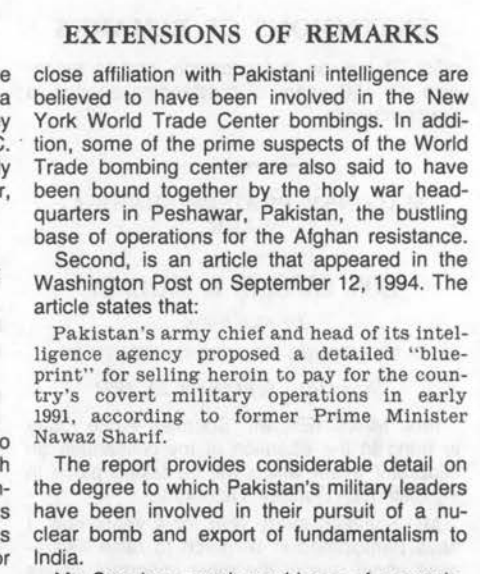
As seen above, in September 1994, U.S. officials were increasingly alarmed by Pakistan’s ongoing support for Gulbuddin Hekmatyar and the relatively newer phenomenon of armed resistance in Kashmir.
It was during this period that the idea of Pakistan as a state sponsor of terrorism began to take shape—an image that would become a defining feature of how the United States framed it in the years to come. As reflected in remarks made in the U.S. House of Representatives, this portrayal of Pakistan as a “terror nation” was frequently tied to its pursuit of a nuclear weapons program, and later, its publicly acknowledged nuclear capability.
To understand what may lie beneath some of Ahmed Rashid’s historical revisionism, one must first understand Gulbuddin Hekmatyar: Afghanistan’s most “persistent insurgent“, and arguably the most reviled by the United States.
Initially aligned with the PDPA, Hekmatyar broke ranks in the mid-1970s to pursue an anti-imperialist Islamic revolution—a struggle that would eventually lead many Western analysts to label him the “Afghan Khomeini.”
In 1989, the United States pressured then–Prime Minister Benazir Bhutto to curb the flow of arms that Pakistan’s Inter-Services Intelligence (ISI) was supplying to Hekmatyar’s forces. Although Bhutto complied relatively quickly—ousting notoriously anti-American former ISI chief General Hamid Gul—but she was soon overthrown—with the tacit support of the military-intelligence establishment.
As a side note, it is often claimed that Bhutto dismissed Gul due to the failed Jalalabad offensive, which mainstream media attributed to Pakistan. However, reports from 1989 indicate that the operation was, in fact, according U.S. officials, largely an American initiative. This raises questions—particularly in light of Bhutto’s later documented disagreements over Afghanistan policy—about the deeper motivations behind Gul’s removal from his position.
In the aftermath, Pakistan’s backing for Hekmatyar resumed, returning to business as usual.
Given that the Taliban’s earliest offensives were directed at Hekmatyar’s forces, and that his movement was effectively sidelined by their rise, it is worth asking who truly benefited. The answer, often obscured in mainstream accounts, appears to be the United States and the Northern Alliance.
While the Northern Alliance had long been engaged in a bloody struggle against Hekmatyar for control of Kabul, their response to the Taliban’s advance was curiously restrained. Rather than resist, they quietly withdrew to the North, citing a desire to “avoid bloodshed.”
The timing and nature of this retreat—combined with the absence of serious early confrontation—raises the question of tacit collusion, or at the very least, a shared interest in removing Hekmatyar as a common obstacle.
In 1996, as the Taliban were consolidating control over most of Afghanistan, The New York Times reported:
“Mr. Ghafoorzai said he hoped Afghanistan’s former King, Zahir Shah, who was ousted in 1973 and lives in Rome, would return to the country because even the Taliban would accept him in a leadership role.”
“Taliban leaders, who said they had not met any resistance from [Rabbani’s] Government forces, vowed to enforce an Islamic system in Afghanistan. A statement by Mullah Omar, quoted by the Afghan Islamic Press news agency in Pakistan, declared Afghanistan a ”completely Islamic state” where a ”complete Islamic system will be enforced.”
Of all the mujahideen factions that fought the Soviet-backed government, Hekmatyar’s Hezb-e-Islami was the only one that staunchly opposed the return of King Zahir Shah. For Pakistan’s military and intelligence establishment, this position was crucial, as the exiled king was not only aligned with India, but had long supported Pashtun and Baloch separatist movements.
The Taliban movement emerged from Kandahar—one of the few Pashtun strongholds of monarchist loyalty. That Pakistan would abandon Hekmatyar in favor of a force rooted in allegiance to the political tradition it had spent years trying to suppress is a contradiction that cannot be explained by convenience or strategy alone.
Notably, the Taliban never actually reinstated King Zahir Shah, despite emerging from a region and clans traditionally loyal to him. After seizing Kabul in 1996 and facing growing resistance from the Northern Alliance—who were initially restrained in their opposition—the Taliban became increasingly dependent on Pakistan’s support.
Part 2 will explore Benazir Bhutto’s alleged role in the Taliban’s origin, the trans-Afghanistan pipeline project, and of course, more of Ahmed Rashid’s historical revisionism.
