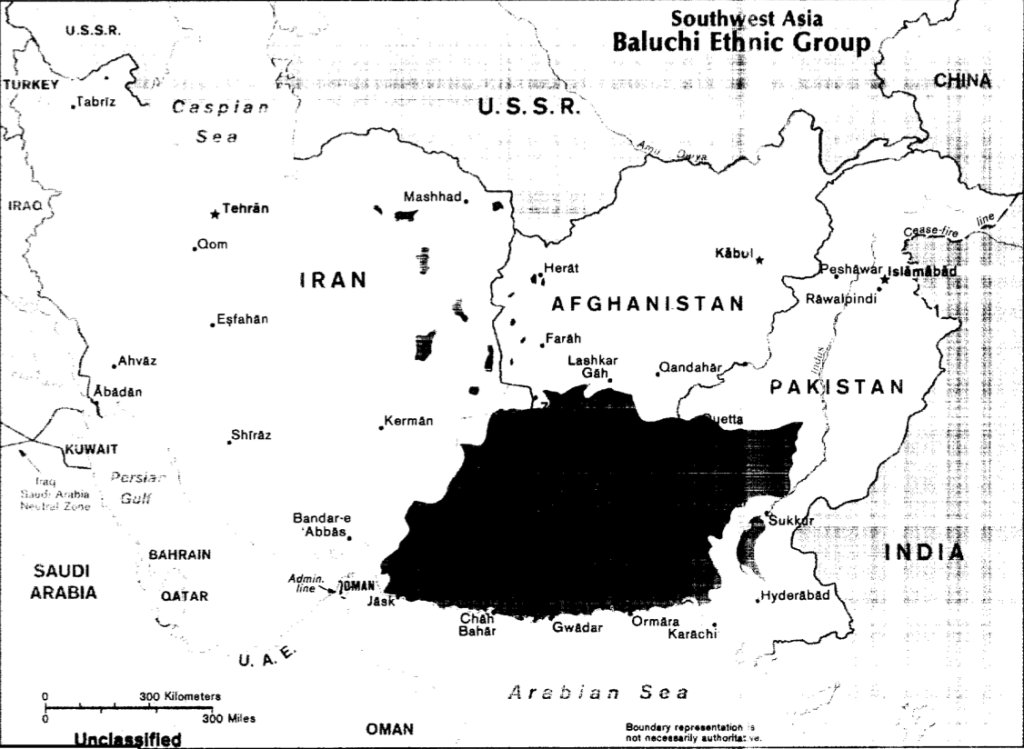
Across the political spectrum in Pakistan, there’s a prevailing myth of Iran supporting secular Baloch militants, while Pakistan does the same with Sunni Islamist Baloch militants. The origin of these claims lay in War on Terror era media lies, primarily from the West.
The table below displays militant groups that have conducted at least one attack in the Iran-Pakistan Balochistan insurgency since 2000.
| Group | Active | Target | Ideology | Base | Allies |
| Jundallah (Iran) | 2003-2012 | Iran | Anti-shia, Baloch ethnic nationalism | Iran, Afg, Pak border regions | ISIS, Jundallah (Pak)?, TTP, LeJ, Al Qaeda, Islamic Movement of Uzbekistan |
| Jundallah (Pakistan)* (TTP “splinter”) | 2003-? | Pakistan, Iran | Anti-shia? | Iran, Afg, Pak border regions | ISIS, Jundallah (Iran)?, TTP, Islamic Movement of Uzbekistan, Al Qaeda |
| Jaish Al Adl (formerly Jundallah) | Since 2012 | Iran | Anti-shia, Baloch ethnic nationalism | Iran, Afg, Pak border regions | (same as Jundallah) |
| Ansar Al-Furqan | Since 2013 | Iran | Anti-shia, Baloch ethnic nationalism | Iran, Afg, Pak border regions | Al Nusra Front, HTS (U.S.-backed terror regime of Syria), ISIS, Al Qaeda, Jundallah |
| Harakat Ansar | 2012-2013 | Iran | Anti-shia, Baloch ethnic nationalism | Iran, Afg, Pak border regions | Al Qaeda |
| Lashkar-e-Jhangvi (LeJ) | Since 2003 | Pakistan | Anti-shia | Balochistan (Pak) | Jundallah, ISIS, TTP |
| Tehrik-e-Taliban Pakistan (TTP) | Since 2007 | Pakistan | Anti-shia | Afg, Balochistan (Pak) | ISIS, Jundallah, BLA (as of 2023), TTP also participated in “jihad” against Bashar Al Assad |
| Jamaat-ul-Ahrar (TTP faction) | Since 2014 | Pakistan | Anti-shia | Unclear? Afg, Pak | (same as TTP) |
| Islamic State Khorasan Province (ISKP) | Since 2015 | Iran, Afghanistan, Pakistan | Anti-shia | Mastung, Balochistan (Pak) | ISIS, Al Qaeda |
| Islamic State Pakistan Province (ISPP) | Since 2019 | Iran, Pakistan | Anti-shia | Mastung, Balochistan (Pak) | ISIS, Al Qaeda |
| Lashkar-e-Balochistan (LeB) | 2012, one-off | Pakistan | Baloch ethnic nationalism | Unknown | NA |
| Baloch Liberation Army (BLA) | Since 2000 | Pakistan | Baloch ethnic nationalism, sectarianism | Mastung, Balochistan (Pak) Afg (multiple cities) | Pak-based Baloch ethnic sectarian militants, TTP (as of 2023?) |
| Baloch Liberation Front (BLF) | Since 2004 | Pakistan, previously Iran | Baloch ethnic nationalism, sectarianism | Suspected camps across the border in Iran (targeted by Pakistan strikes) | Pak-based Baloch ethnic sectarian militants |
| Baloch Republican Army (BRA) | Since 2006 | Pakistan | Baloch ethnic nationalism, sectarianism | Balochistan (specifics unclear), Afg | Pak-based Baloch ethnic sectarian militants |
| United Baloch Army (UBA) (founded by leader of BLA, Hyrbyair Marri’s*** brother, Mehran Marri after they had a fight) | 2012-2022 | Pakistan | Baloch ethnic nationalism, sectarianism | Balochistan (specifics unclear), Afg | Pak-based Baloch ethnic sectarian militants |
| Baloch Nationalist Army (BNA)** | 2022-? | Pakistan | Baloch ethnic nationalism, sectarianism | Unknown, suspected in Iran (BNA and BLF have had clashes in Iran) | Pak-based Baloch ethnic sectarian militants |
*Towards the end of this article, we have covered the contradictions around Jundallah (Pakistan) and whether it can reasonably be distinguished from Jundallah (Iran).
**BNA is allegedly a successor to BRA which was founded by Brahamdagh Bugti. However, this may be a rebranding effort as Bugti is comfortably living in political asylum in Switzerland despite documented links to terrorism. In 2009, the U.S. Embassy was certain Bugti was hiding in Afghanistan under the watch of Hamid Karzai’s NATO-backed government.
Karzai ensured U.S. officials that he would urge Bugti to “do the right thing” and release kidnapped UNHCR head, John Solecki.
***Given that Hybyair Marri, like Bugti, was also granted political asylum in a Western country, it is far more likely that recent claims of a “split” in BLA are unsubstantiated and aimed at distancing the “ideological” leaders of the movement from the fighters on the ground. To keep this article focused, we’ll save that topic for another time.
Miltant Bases
In the aftermath of the brief—and, according to many analysts, likely pre-coordinated—missile exchanges between the two countries, familiar claims that Pakistan and Iran are backing Baloch separatist militants against each other have resurfaced, despite a lack of credible evidence.
Some observers have argued that the mere presence of a militant group’s base within a country is, in itself, sufficient “evidence” that the host state is actively supporting the group.
It’s a simplistic and, frankly, absurd claim. To highlight just how flawed this logic is, let’s apply it to other parts of the world.
If militant bases imply state backing, then one could just as easily argue:
- Bashar Al Assad was supporting the FSA, ISIS, HTS, and other militant groups against his own rule.
- Pakistan is supporting BLA, UBA, ISKP, ISPP, and other militant groups against its state institutions and territorial integrity.
- Muamar Gaddafi was supporting the LIFG (Al Qaeda affiliate) and other militant groups against his own rule.
- India is supporting Kashmiri militant groups against its own state institutions.
- India is supporting Maoist militants against its own state institutions.
- Afghanistan is supporting ISKP and other militant groups against its own state institutions.
It’s difficult to be certain where militant bases are located, as these can shift over time or with relative frequency. Ultimately, these are more reflective of the inherently porous borders characteristic of Pakistan, Iran, and Afghanistan’s mountainous regions.
It’s important to consider that this was a time when the U.S. was at in Iraq and Afghanistan, with hundreds of CIA officials operating in Pakistan. Many analysts have referred to America’s coercive presence, drone strikes, and military operations in Pakistan as acts of war as well. Under the Obama administration, the war in Afghanistan was referred to as “AfPak“.
As a reminder of the coercion that led to Pakistan’s involvement in the War on Terror, a U.S. defense intelligence report notes:
“No other Asian country, excepting Afghanistan, has had to make more risk-filled policy decisions — or to make them under greater duress — in the wake of 9/11 than Pakistan.”
“Washington’s almost immediate identification of Taliban-ruled Afghanistan as state sponsor of the al Qaeda terrorist network and, thus, as active accomplice to the terrorist attacks and logical first target in the Global War on Terrorism (GWOT), plunged the Army-ruled government of Pakistan into acute crisis.”
“Pakistan’s geographic proximity to Afghanistan made it a primary candidate for renewed alliance with the United States. Also arguing for alliance with the United States were neighboring India’s prompt offer to Washington of total support in the war on Afghanistan and Pakistan’s dire military and economic weaknesses. By no means least among Pakistani calculations, however, was the possibility of punishment by Washington — conceivably even military punishment — if Islamabad made the wrong choice.“
1970s Balochistan Insurgency in Iran and Pakistan
The Baloch Liberation Front (BLF) was founded in 1964, in Damascus, Syria, by Jumma Khan Mari, a Pakistani Baloch. Soon after, the group waged an insurgency in Iran’s Sistan-Baluchistan province.
Iraq—whose Soviet-leaning leader had recently been overthrown in a coup that analysts believe was orchestrated by the CIA—openly armed the militants. Given that Iran and Iraq have had tense relations spanning political leaders of all sorts of ideologies and foreign alliances, it’s very probable that Iraq acted alone.
It is often alleged that the militants received support from the Soviet Union. However, declassified CIA files, including one from 1980 titled “Balochistan: Iran’s Weakest Link?“, reveal that the Soviets had thus far, not supported the insurgents in Iran or Pakistan.
In his book, “In Afghanistan’s Shadow: Baluch Nationalism and Soviet Temptations“, Selig Harrison, a hawkish U.S. foreign policy “expert” with deep ties to the U.S. empire, reaffirms this fact. However, he noted that both the Pakistani Baloch insurgents and the Soviets were likely leveraging perceptions of their relationship to pressure Islamabad.
For the Soviets, the aim was to gain concessions regarding the situation in Afghanistan; for the Baloch, it was to extract political and economic gains. Khair Baksh Marri, key leader of the movement, had leaned towards independence, while Ataullah Mengal was willing to accept greater provincial autonomy.
Pakistan received significant support from Iran in their 1970s military operation against the insurgents, including help from Iranian officers on the ground.
This instance already sets the stage for what was historically perceived as a shared threat. After this period, the insurgency was all but nonexistent for over twenty years.
Jundallah: Sunni Extremism or Baloch Ethnic Nationalism?
A common misconception about Jundallah is that it’s purely a Sunni extremist group.
In 2010, Stratfor, a global “intelligence” sharing firm that works closely with the U.S. security state, “found” that:
“Jundallah means “Soldiers of God” (though the group also calls itself the People’s Resistance Movement of Iran). Rigi, a charismatic and capable young Balochi, created the group in the early 2000s in the village of Nahug near the city of Saravan in Sistan-Balochistan province near the Pakistani border.”
“Rigi’s use of jihadist ideology seems more opportunistic than genuine, as Jundallah is still more of an ethno-nationalist militant group.”
Note that the above quote is pulled from what appears to be an article being prepared for the public. It’s possible in the aftermath of controversies around Jundallah’s ties to Western intelligence agencies, Stratfor sought to paint a more moderate image of the group.
Open source “Intelligence” sharing platforms like Bellingcat and Stratfor have frequently come under the radar of anti-imperialist journalists for acting more as propaganda peddlers than sharing legitimate intel.
Like Al Qaeda terrorists in Syria, Stratfor portrays Jundallah’s founder as “charismatic” and “capable”. Similarly, Western media outlets, even after Jundallah had been designated as a terrorist group by the U.S., continued referring to its members as “rebels“.
In 2007, Amnesty International was deeply concerned about Iran cracking down on terrorists from Jundallah, rebranding them as activists. This is a common strategy of U.S.-backed “human rights” groups. Similar claims were made against Bashar Al Assad for “terrorizing” the 100,000+ jihadis the West sent to his country.
In Syria, organizations such as “The White Hlelmets” and “Syrian Network for Human Rights” played a monumental role in downplaying, covering up, and legitimizing the murder of thousands of minorities at the hands of these jihadis. Interestingly, in Pakistan, drawing this connection with respect to the insurgency in Balochistan is strongly condemned and outright rejected even by “anti-imperialists” well aware of similar tactics in other countries.
CIA’s Covert Support for Jundallah and Western Media Propaganda
In 2000, an attack in Quetta, Balochistan, was claimed by the Baloch Liberation Army (BLA). This appeared to be an anomaly, however, and there were no documented Baloch separatist attacks again until 2003.
In mainstream media and the rhetoric of Baloch ethnic nationalist discourse, the dominant narrative is that the insurgency started in 2006, after the killing of Nawab (“prince”/feudal landlord) Akbar Khan Bugti.
Frequently overlooked is the fact that, coincidentally, the insurgencies in Iran and Pakistan suddenly remerged around the same time. In May 2003, BLA carried out a string of attacks against non-native residents of Balochistan, while Jundallah, conducted an attack earlier in February 2003.
In 2007, ABC News reported that Bush had authorized a covert CIA scheme to destabilize the Iranian government.
“The United States has supported and encouraged an Iranian militant group, Jundullah, that has conducted deadly raids inside Iran from bases on the rugged Iran-Pakistan-Afghanistan ‘tri-border region.’”
“American intelligence sources say Jundullah has received money and weapons through the Afghanistan and Pakistan military and Pakistan’s intelligence service. Pakistan has officially denied any connection.”
Even more notable, is that shortly after this report, not only did Pakistan slam the accusations, but Iran exclusively acknowledged U.S. involvement, rejecting the blame assigned to Pakistan.
A follow-up article by ABC news states:
“The Iranian government appeared to embrace ABC News’ reporting that the United States was backing anti-government forces in its country. “There is no doubt in our minds that the United States spares no effort to put pressure on the Islamic Republic of Iran,” said Gholamali Haddadadel, speaker of the Iranian parliament.”
“But he too played down the notion of any involvement by its neighbor, Pakistan, in the U.S. effort. “We don’t have any reason to believe that the military establishment in Pakistan is also supporting such militants groups,” Haddadadel said via an interpreter, according to Reuters.”
“On Thursday, a spokesman for the Pakistani military also disputed the ABC News report in an interview with ABC News. “It is totally untrue to say our intelligence agencies have anything to do with Jundullah,” said General Wahid Arshad, Pakistan’s chief military spokesman.”
Despite this, the article attempts to portray a different narrative to implicate Pakistan, adding that:
“But according to ABC News consultant Alexis Debat, who just returned from the region, Pakistani intelligence recently facilitated the payment of $1.3 million by Iran to Jundullah to obtain the release of kidnapped Iranian border guards, ‘They (the Iranians) are escorted by Pakistani intelligence into Pakistan to meet with Jundullah officials and probably Regi himself to make the exchange to give the money and get the hostages back. So Pakistani intelligence in many ways is involved in that.’”
It is clear that the payment in question was coordinated between Pakistan and Iran to fulfill a ransom demand—one that Iran had agreed to. In the previous article, ABC News vaguely attributes payments to Jundallah to Pakistan’s military-intelligence apparatus, implying direct support without clarifying the context. If Iran had genuinely viewed this as Pakistani support for Jundallah, it would not have publicly rejected ABC’s claims.
These two articles demonstrate a clear contradiction: while acknowledging that Jundallah was a covert operation linked to the Bush administration, Western media simultaneously attempted to shift responsibility onto Pakistan—suggesting a deliberate effort to misrepresent the situation.
In 2010, BBC news reported that Abdolmalek Rigi, the founder and former leader of Jundallah, was captured and executed by the Iranian government. Prior to his execution, local media released footage of him confessing to receiving U.S. military support.
“In the tape, Mr Rigi alleged that the US had promised to provide his group with military equipment and a base in Afghanistan, near the Iranian border.”
“He says he was on his way to a meeting with a “high-ranking person” at the Manas US military base in Kyrgyzstan when he was captured.”
While it’s reasonable to question whether he made the statement under duress, it’s notable that despite the confession having no mention of Pakistan’s support for Jundallah, BBC still frames the country as a partner in covert operations against its neighbor, claiming Rigi and Jundallah were “accused by Iran of links with the US and Pakistan“.
If this were the case, why did Rigi not highlight Pakistan in his confession? And, suppose, if it was made under duress, wouldn’t it have been a golden opportunity for Iran to publicly tie Pakistan to Jundallah? BBC makes no mention of the reports published by ABC News three years prior, naturally.
In 2008, Iranian media outlet Press TV reported:
“Pakistan’s former Army Chief, Retired General Mirza Aslam Baig, says the US is supporting the outlawed Jundullah group to destabilize Iran. He said that the US is providing training facilities to Jundullah fighters–located in eastern areas of Iran–to create unrest in the area and affect the cordial ties between Iran and its neighbor Pakistan.”
“The intelligence agencies of the coalition forces are very active in Afghanistan and work against the interests of Iran, Pakistan, China and Russia in the region….”
The U.S. Deflects Responsibility to Mossad
CIA’s covert support for extremist groups against Iran drew significant criticism. Under the Obama administration, the United States began actively discrediting claims linking the CIA to Jundallah.
In 2008, ABC News launched a “probe” into one of the sources, Alexis Debat, who had gathered intel for the original report.
Debat, former Director of the Terrorism and National Security Program at the Nixon Center, resigned from ABC News following the conspiracy. Other Western media outlets, such as The Guardian and The Washington Post, joined the character assassination campaign as well.
However, The Telegraph, a U.K.-based media outlet, had also reported on Jundallah’s covert support from the CIA, citing different intel sources.
The article notes:
“Funding for their separatist causes comes directly from the CIA’s classified budget but is now “no great secret”, according to one former high-ranking CIA official in Washington who spoke anonymously to The Sunday Telegraph. His claims were backed by Fred Burton, a former US state department counter-terrorism agent, who said: ‘The latest attacks inside Iran fall in line with US efforts to supply and train Iran’s ethnic minorities to destabilise the Iranian regime.’”
Eventually, the U.S. deflected responsibility onto Israeli intelligence agency Mossad.
A 2012 report published by Foreign Policy claimed:
“According to two U.S. intelligence officials, the Israelis, flush with American dollars and toting U.S. passports, posed as CIA officers in recruiting Jundallah operatives — what is commonly referred to as a “false flag” operation.“
“The memos, as described by the sources, one of whom has read them and another who is intimately familiar with the case, investigated and debunked reports from 2007 and 2008 accusing the CIA, at the direction of the White House, of covertly supporting Jundallah — a Pakistan-based Sunni extremist organization.”
It’s certainly possible Mossad was involved in Jundallah’s recruitment. I would go as far as to say I’d be surprised if the U.S. didn’t allow its best friend to partake in its covert schemes in West Asia. However, the idea that it took the U.S. five years to “discover” Mossad’s involvement, as claimed, is dubious, considering it took them roughly two days to determine, with utmost certainty, that Osama bin Laden was behind the 9/11 attacks.
Nonetheless, the damage had already been done. Jundallah rebranded in 2012, now going by the name “Jaish-Al-Adl“.
Jundallah (Pakistan) and Jundallah (Iran)
It remains unclear whether “Jundallah (Pakistan)” is truly a distinct group or simply a construct amplified by a Western-dominated media and information landscape to divert attention from its links to the Tehrik-i-Taliban Pakistan (TTP), Islamic Movement of Uzbekistan, Jundallah (Iran), and other brutal sectarian groups.
There are glaring contradictions in the narrative around Jundallah (Pakistan).
For example, the Mapping Militants page for the group states it was formed in 2003, four years prior to the formation of TTP but the same year Jundallah (Iran) was formed.
Yet, mainstream media outlets, including the NATO-aligned Pakistani outlet Dawn, refer to it as a “splinter” group of TTP in 2013. Both factions of Jundallah are frequently described as “shadowy” and are known to operate with a high degree of secrecy.
As we’ve noted in part 1 of our LeJ series, everywhere the U.S. stepped foot after 9/11, sectarian violence mysteriously erupted—this should always be considered in such cases. Sectarian militants typically destabilize nations, but they do not primarily target Western interests.
Jundallah (Pakistan) has been responsible for brutal sectarian violence against civilians in Pakistan. However, its notable early attacks were against senior ranking army officials in Pakistan, such as in 2004, when it attempted to assassinate the commander of Karachi V Corps, General Ahsan Saleem Hayat.
In 2004, Dawn reported:
“Police formally charged on Thursday the activists of a militant outfit, Jundullah, arrested in cases pertaining to attack on corps commander’s motorcade , law-enforcers’ killing, blasts at Pak-American Cultural Centre, Pakistan Bible Society, Marina Club, besides other killing cases.”
At this point in time, there was no distinction made between Jundallah (Iran) and Jundallah (Pakistan).
This distinction only appears in 2007, after the ABC News report of the CIA’s links to Jundallah.
On April 5th, 2007, one day after it was revealed that Jundallah was founded via a covert CIA scheme under the Bush administration, Stratfor sent a “global intelligence brief” email to all its employees about the incident. The email states:
“Stratfor has been examining the U.S. connection to Jundallah’s activities in Iran for some time now. These activities serve as a poking device for the United States to use against Iran in the diplomatic tango over Iraq. The group’s origins are murky, but it appears to have surfaced in 2003 under the leadership of a 23-year-old Sunni ethnic Balochi who goes by the name Abdolmalek Righi.”
“Jundallah, or “Soldiers of God,” is not to be confused with the more jihadist-oriented Pakistani group by the same name that was responsible for the 2004 attack against Gen. Ahsan Saleem Hayat, Pakistani President Gen. Pervez Musharraf’s deputy.”
There’s no explanation provided for why Jundallah, the Iran-focused group that mysteriously emerged in 2003, is “not to be confused” with Jundallah, the Pakistan-focused group that also mysteriously emerged in 2003 and was never distinguished as a separate entity until one day after the ABC News report of CIA involvement.
We strongly recommend listening to this podcast episode (sources provided) with investigative anti-imperialist journalist Kit Klarenberg on “information warfare networks“, which include intelligence firms like Stratfor.
We will continue coming back to and referencing this story as much of it is intrinsically related to our other coverage of the War on Terror—an era that needs serious revisiting in anti-imperialist circles of Pakistan.
